


Westside Dental Center Blog·Patient Guides
Deep Cleaning (Scaling and Root Planing): What to Expect and Why It Matters
Short answer: A deep cleaning, also called scaling and root planing, removes plaque and hardened tartar from below the gum line and smooths the tooth roots so gums affected by gum disease can heal. The area is numbed first, the work is done in one or two visits, and most people go back to their normal routine the same day.
If your dentist or hygienist has recommended a deep cleaning, you probably have questions. How is it different from a regular cleaning? Does it hurt? What does it cost? Deep cleaning teeth is one of the most effective ways to stop gum disease before it damages the bone that holds your teeth in place, and this guide walks you through it step by step.
At Westside Dental Center, deep cleanings are part of our gum disease treatment in Plantation, with care led by Dr. Uttma Dham and board-certified periodontist Dr. Sawan Malik.
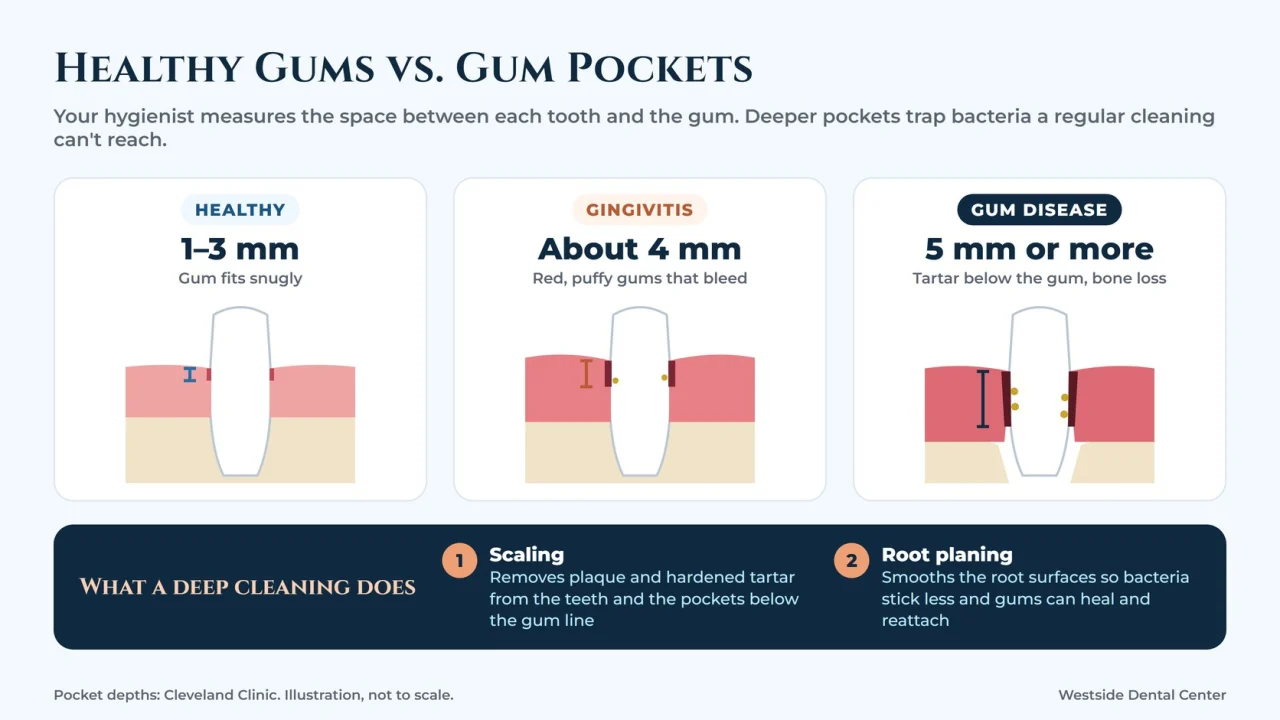
What Is a Deep Cleaning for Teeth?
A deep cleaning is a non-surgical gum treatment that cleans below the gum line, inside the pockets that form around your teeth when gum disease starts. It has two parts:
- Scaling: removing plaque and hardened tartar from your teeth and from the pockets below the gum line.
- Root planing: smoothing the root surfaces so bacteria have a harder time sticking, which helps your gums heal and reattach to your teeth.
A regular cleaning, called a prophylaxis or "prophy," is different. It removes plaque and tartar from your teeth and just below the gum line, then polishes your teeth smooth. It's designed for healthy gums. In short, a regular cleaning maintains healthy gums, while a deep cleaning helps unhealthy gums heal.
How Is a Deep Cleaning Different From a Regular Cleaning?
The main difference is how far below the gum line the cleaning reaches and who it's for. Here's a side-by-side look:
| Question | Regular cleaning | Deep cleaning |
|---|---|---|
| Who it's for | Healthy gums | Gums affected by gum disease |
| Where it cleans | Teeth and just below the gum line | Deeper into the gum pockets, plus the roots |
| Numbing | Rarely needed | The area is numbed |
| Visits | Part of your routine checkup | One or two visits, often half the mouth at a time |
| What comes next | A cleaning about every six months | Periodontal maintenance every three to four months |
If your gums are healthy, your routine cleanings are part of our dental hygiene care.
How Do You Know If You Need a Deep Cleaning?
Your hygienist can tell by measuring your gum pockets and checking your X-rays. Gum disease is common: about 4 in 10 U.S. adults 30 or older have some level of periodontitis, according to the CDC. The tricky part is that it often doesn't hurt in the early stages. Watch for:
- Gums that bleed when you brush or floss
- Red, swollen, or tender gums
- Bad breath that doesn't go away
- Gums that are pulling away from your teeth
- Loose or shifting teeth, or a change in your bite
- Pus between your teeth and gums
At your exam, your hygienist gently measures the space between each tooth and the gum, called the pocket depth. According to Cleveland Clinic, healthy pockets measure 1 to 3 millimeters, pockets can reach 4 millimeters with gingivitis, and they measure 5 millimeters or more with periodontal disease. When pockets deepen and gums bleed, a regular cleaning can no longer reach the bacteria causing the problem.
We also review your X-rays with Overjet AI, an FDA-cleared tool that highlights findings directly on your X-rays. If it has been a while since your last checkup, our guide to your first dental visit explains how a new patient exam works.
Why Does a Deep Cleaning Matter?
Because untreated gum disease doesn't just affect your gums. Over time, the infection can damage the bone that supports your teeth, leading to loose teeth and even tooth loss. A deep cleaning removes the bacteria and tartar that drive this process, so your gums can calm down and heal.
Periodontitis can't be fully cured, but it can be controlled. Treatment stops the infection, and regular maintenance keeps it from coming back. Lost bone doesn't regrow on its own, which is why treating gum disease early matters.
What Happens During a Deep Cleaning?
A deep cleaning usually takes one to two hours, and it follows the same four steps:
- Evaluation: we review your gum measurements and X-rays to plan which areas need treatment.
- Numbing: the area is numbed so you stay comfortable. If you have sensitive teeth, tell your hygienist so they can adjust.
- Scaling and root planing: your hygienist carefully cleans below the gum line and smooths the root surfaces.
- Follow-up: we check how your gums are healing and set up a plan to keep them healthy.
Depending on how many areas need treatment, your deep cleaning may be done in one visit or split into two, often treating half of your mouth at a time, as Cleveland Clinic describes.
Does a Deep Cleaning Hurt?
Because the area is numbed, most people feel pressure rather than pain during treatment. Afterward, some tenderness and sensitivity to hot or cold for a few days is normal as your gums begin to heal. Most people go right back to their normal routine the same day.
Bleeding, swollen, or tender gums? See how we treat gum disease at Westside Dental Center →
What Should You Do After a Deep Cleaning?
Good home care helps your gums heal and keeps your results lasting:
- Brush gently twice a day with a soft-bristled toothbrush.
- Floss or use interdental brushes every day.
- Expect some mild sensitivity for a few days.
- Avoid smoking, which slows healing and raises your risk of gum disease.
- Keep all your follow-up appointments.
Why Periodontal Maintenance Visits Matter
After a deep cleaning, regular six-month cleanings usually aren't enough. Instead, you'll typically need periodontal maintenance, specialized cleanings every three to four months, to keep bacteria under control and stop gum disease from returning.
Are There Downsides to a Deep Cleaning?
A deep cleaning is a routine, low-risk treatment, but it helps to know what's normal afterward. Cleveland Clinic lists these possible side effects:
- Some bleeding: a little bleeding afterward is normal. Call us if it doesn't stop.
- Sensitivity: once the tartar is gone, teeth can feel more sensitive to hot and cold for a while.
- Teeth that feel slightly loose: they may feel a little wiggly at first, which should settle as your gums tighten back up.
- Small gaps or more visible roots: swollen gums shrink back once the infection clears, so you may see a little more of your tooth roots.
Is a deep cleaning really necessary? If your pockets have deepened, yes. Brushing and flossing can't reach far enough below the gum line to remove the tartar that drives gum disease, so a professional deep cleaning is the way to clear it.
What If You Need More Than a Deep Cleaning?
For more advanced gum disease, Westside Dental Center offers additional care in our office, led by board-certified periodontist Dr. Sawan Malik:
- Laser gum treatment: the Fotona laser removes infected gum tissue and reduces bacteria deep in the gum pocket.
- Advanced and surgical care: when it's needed, treatments such as gum grafting for recession, pocket reduction, and bone grafting help repair damage and protect your teeth.
- Dental implants: if a tooth can't be saved, it can be replaced with a dental implant.

How Much Does a Deep Cleaning Cost?
Deep cleaning teeth is usually priced per quadrant, one quarter of your mouth, so the total depends on how many areas need treatment. For a sense of typical prices, CareCredit's scaling and root planing cost guide (December 2024) reports these figures from its 2024 cost study. They are typical prices before insurance, not Westside Dental Center's fees:
| Price | Amount | What it covers |
|---|---|---|
| U.S. average | $242 | One quadrant (a quarter of your mouth), before insurance |
| Typical U.S. range | $185 to $444 | One quadrant, depending on the practice and where you live |
| Florida average | $237 | One quadrant, before insurance, from the same 2024 study |
Your own cost depends on how advanced your gum disease is, how many quadrants need treatment, and which treatment you need. You'll get a clear estimate before we begin. Many dental insurance plans cover part of a deep cleaning and periodontal maintenance, and we're in-network with most PPO plans and file your claim at the time of your visit. You can learn about payment options on our insurance and financing page.
Protect Your Gums in Plantation
If your gums bleed, feel tender, or seem to be pulling away from your teeth, don't wait. Early treatment is simpler and helps you keep your natural teeth. At Westside Dental Center, our team will check your gums and explain the treatment that fits, from a deep cleaning to laser gum treatment and periodontal care.
Call or text us at (954) 476-4535 or visit us at 51 NW 100 Ave, Plantation, FL 33324 to book your gum evaluation.
Frequently asked questions
Is a deep cleaning different from a regular cleaning?
Yes. A regular cleaning cleans your teeth and just below the gum line for healthy gums. A deep cleaning, or scaling and root planing, cleans deeper into the gum pockets and smooths the roots so gums affected by gum disease can heal.
Does a deep cleaning hurt?
The area is numbed, so most people feel pressure rather than pain. Some tenderness and sensitivity to hot or cold for a few days afterward is normal.
How long does a deep cleaning take?
A deep cleaning usually takes one to two hours. It may be done in one visit or split into two, often treating half of your mouth at a time.
How much does a deep cleaning cost?
It is usually priced per quadrant. CareCredit's 2024 cost study puts the U.S. average at $242 per quadrant ($237 in Florida) before insurance. You'll get a clear estimate before treatment begins.
Does insurance cover a deep cleaning?
Many dental insurance plans cover part of a deep cleaning and periodontal maintenance. Westside Dental Center is in-network with most PPO plans and files your claim at the time of your visit.
How often will I need cleanings afterward?
Most people need periodontal maintenance every three to four months after a deep cleaning to keep gum disease under control.
Can gum disease be cured?
Periodontitis can't be fully cured, but it can be controlled. Treatment stops the infection, and regular maintenance keeps it from coming back.
Keep reading
Related guides

New & existing patients